Understand Victorian rooms as varied revivals, not one cluttered look
Victorian is a period label containing many approaches to furniture and decoration. A heavily ornamented room is one possible reference, not a complete definition. Learn to separate period, revival style and present-day interpretation, then choose the density and detail you actually want in a usable contemporary room.
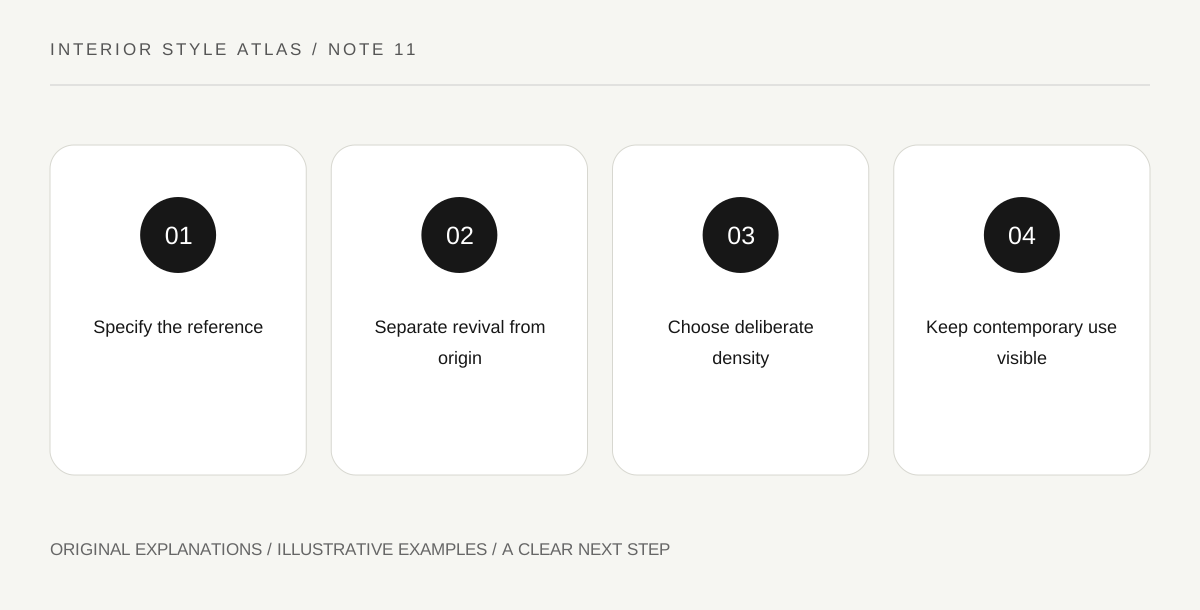
Original explanatory diagram. Read the full method and limitations below.
Ask which Victorian reference is intended
A nineteenth-century Rococo Revival parlor and an Aesthetic interior can differ significantly even when both fall within a broad Victorian context. Museum examples help reveal that variety. Begin with a specific room or object rather than assume that dark colour, many ornaments and velvet automatically describe the whole period.
Write the exact features that interest you: curved carved seating, layered pattern, artistic display or a particular room arrangement. This makes the reference useful. The period name can remain a historical orientation, but it should not do the work of describing every visual and material decision.
Separate revival from original period design
A nineteenth-century revival can refer to an earlier design language without being an eighteenth-century object. The distinction matters for accurate description and attribution. A contemporary revival adds another layer. Similar motifs across dates do not make those objects historically identical.
For decorating, you can combine different references if you do so knowingly. Keep a note of what is verified and what is simply an impression. Do not label an unknown chair as Victorian solely because it is ornate, and avoid treating a seller’s broad category as documentation of age or maker.
Choose density as a deliberate decision
Layered rooms can use repeated colours, related motifs or clear groups to organize many objects. Density need not mean random accumulation. Conversely, a room influenced by a historic detail can remain relatively open. You do not need to reproduce a museum parlor’s entire quantity of furniture.
Select one display area and identify its main object, supporting pieces and quiet gaps. Check the view from a seated position as well as the doorway. A group can feel rich while leaving useful surfaces clear. The goal is a density you enjoy and can maintain, not a fixed rule about how many objects signify the period.
Keep use and conservation questions distinct
A decorative object can be meaningful while unsuitable for daily handling. Older upholstery, finishes and structures may need appropriate assessment. This article does not give restoration instructions or establish safe use from appearance. Historical style and current condition are separate questions.
For an exercise, create a contemporary arrangement using one documented revival reference and existing everyday furniture. Explain what is borrowed and what is intentionally different. Include the room’s current activities. The result can have historical depth without pretending that your home is an authenticated period room.
Illustrative revival distinction
A reader admires curved seating in the Met’s Rococo Revival parlor but prefers fewer objects. They keep their contemporary sofa, use one curving frame and group three personal objects on a cabinet. Their notes call the idea a contemporary reference to a nineteenth-century revival. They do not describe the modern frame as an eighteenth-century Rococo object or assume age from ornament.
Practical checks
Optional checkboxes save only in this browser.
Questions that come up
Does Victorian always mean maximalist?
No. The period includes varied design movements and approaches. Study specific examples and describe their actual features instead of treating one dense interior as the definition.
Can an ornate chair be dated from a photograph?
A photograph may suggest questions, but ornament alone cannot establish date, maker or alterations. Use documentation and appropriate expertise when attribution or value matters.
References and scope
These sources support the factual background. Examples and exercises are original illustrative teaching material. References do not imply endorsement.
- Getty Museum: Principles of design — Balance, emphasis, repetition, proportion and visual rhythm in original room exercises.
- Getty Museum: Elements of art — Line, form, colour value, space and texture.
- V&A: Aesthetic Movement introduction — Art for art’s sake, artistic domestic display and multiple design influences.
- Metropolitan Museum: Rococo Revival parlor — Nineteenth-century revival interiors and the distinction from eighteenth-century Rococo.
- V&A: Furniture collection — Furniture as diverse objects with construction, material and historical context.