Use Rococo Revival curves without confusing them with eighteenth-century originals
Rococo Revival reinterpreted an earlier ornamental language in a later period. Understanding that distinction helps you use curved forms and decorative detail honestly. Study one documented example, then decide how much of its movement and richness you want in a contemporary room rather than copying every object.
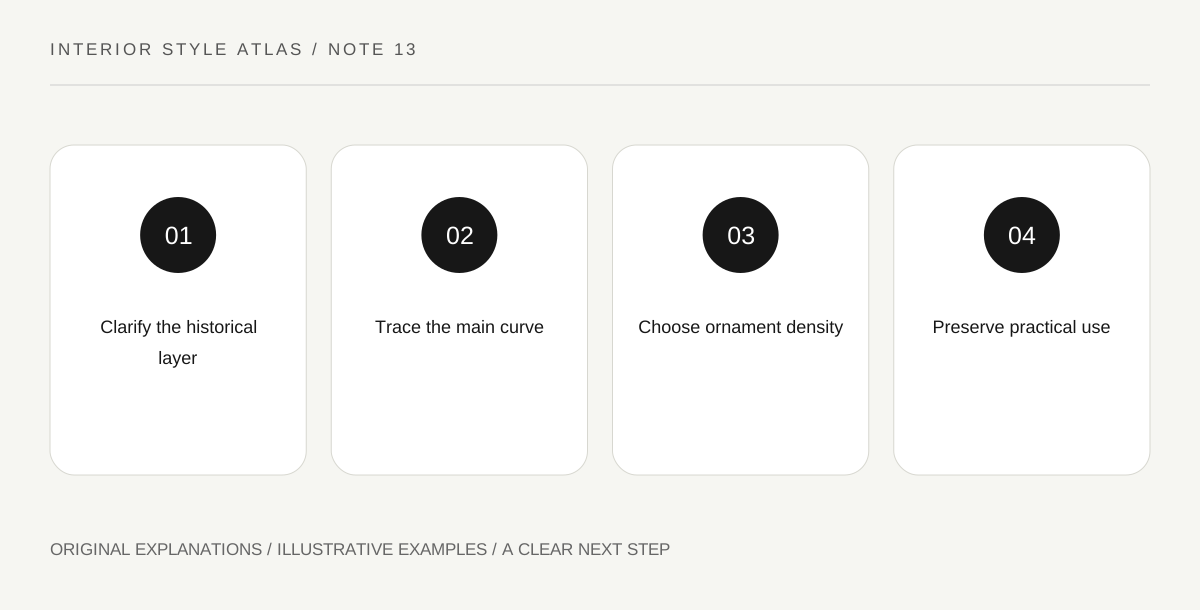
Original explanatory diagram. Read the full method and limitations below.
Keep the revival distinction clear
The Met’s Rococo Revival parlor provides a specific nineteenth-century reference. It is not the same category as an eighteenth-century Rococo interior. Similar scrolls or natural motifs can recur in different periods, so appearance alone does not settle an object’s date or origin.
When describing a contemporary piece, use language such as curved, carved or revival-inspired if that is what you can establish. Do not attach an antique date because a motif looks old. Honest description still allows you to enjoy the form without inventing provenance.
Find the dominant curve
A chair back, table edge or frame may contain several smaller details but have one main outline. Trace that outline before considering every decorative mark. The larger curve often determines how the object relates to the surrounding room.
Place a plain object beside the curving one and notice the contrast. A quiet rectangular surface can make ornament easier to read. You do not need every piece to have the same curve; variation can clarify the reference instead of weakening it.
Look at the outline as a shadow shape before inspecting carving. A plain curving object may carry the movement you enjoy, while a densely carved object may contribute texture instead. Those are different roles in the room.
Control the amount of repeated ornament
Repeating a scroll in a textile or frame can connect an arrangement. Repeating it in every visible object may create a more theatrical result. Decide which degree of richness you want and view the group from a normal distance, where fine details merge into larger textures.
Consider surface finish as well as shape. A reflective finish makes ornament catch light differently from matte paint or wood. The same form can become more or less prominent depending on contrast. Do not assume that gilding or high sheen is required for every contemporary interpretation.
Let daily use set the limits
A heavily detailed object may require care or occupy more visual and physical space than a simple one. Keep usable surfaces and comfortable access. If an object is genuinely old or fragile, obtain suitable advice before cleaning, altering or using it as everyday furniture.
For an exercise, use one curving reference, one plain companion and one textile. Compare a version with repeated ornament against a quieter version. Write which feature you want to borrow and which you would leave in the historical source. This creates a personal room direction without claiming a complete reconstruction.
Illustrative curved-frame study
A reader owns a modern curving mirror and a plain cabinet. They compare a patterned cloth with a solid one beneath a bowl. The patterned version repeats too many small curves for their preference, while the solid cloth lets the mirror lead. They describe the mirror as revival-inspired and do not call it an authenticated Rococo or Victorian object.
Practical checks
Optional checkboxes save only in this browser.
Questions that come up
Is Rococo Revival simply another name for Rococo?
No. Revival identifies a later reinterpretation. When historical accuracy matters, keep the dates and contexts distinct rather than rely only on similar ornament.
Must every companion piece be ornate?
No. Plain forms can make a decorative object easier to appreciate. Choose the amount of contrast and richness you enjoy instead of treating a style reference as a demand for uniform ornament.
References and scope
These sources support the factual background. Examples and exercises are original illustrative teaching material. References do not imply endorsement.
- Getty Museum: Principles of design — Balance, emphasis, repetition, proportion and visual rhythm in original room exercises.
- Getty Museum: Elements of art — Line, form, colour value, space and texture.
- Metropolitan Museum: Rococo Revival parlor — Nineteenth-century revival interiors and the distinction from eighteenth-century Rococo.
- V&A: Furniture collection — Furniture as diverse objects with construction, material and historical context.