Treat Georgian as a period before choosing a room style
Georgian is often used as if it names one exact furniture look, but a long period contains changing tastes and overlapping design languages. Begin by identifying the particular reference you mean. Then use proportion, arrangement and decorative detail deliberately instead of assembling everything sold under the same broad label.
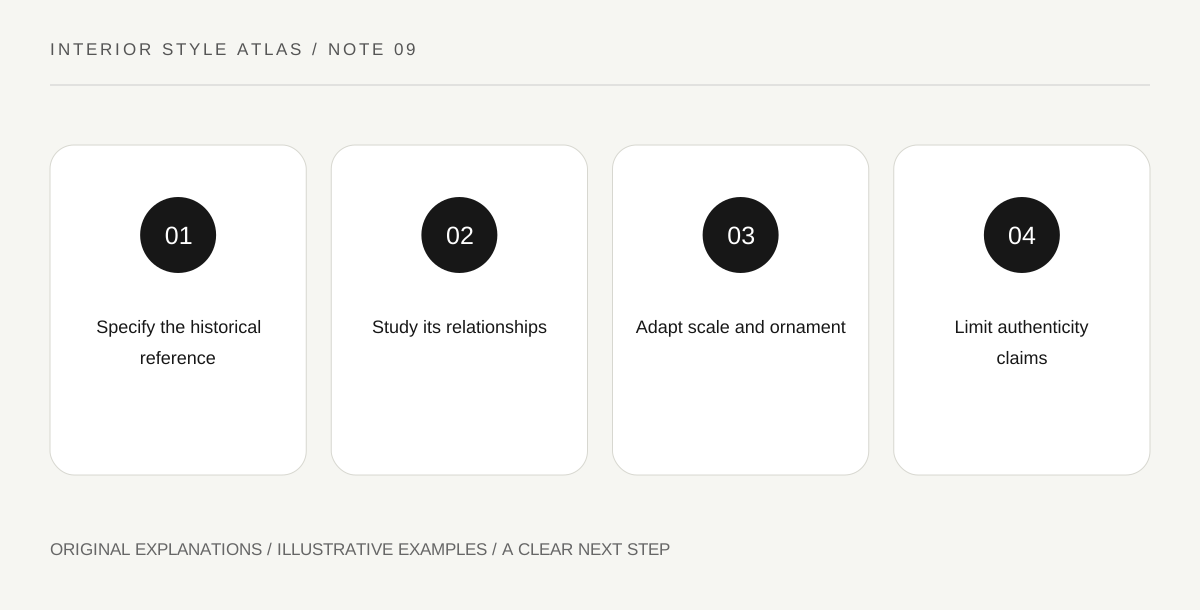
Original explanatory diagram. Read the full method and limitations below.
Ask which object or interior you mean
A period label is not a complete description of a chair or room. Classical references, different furniture forms and changing ornament can coexist within a broad historical span. Choose a documented example and note its date, place and specific features rather than assume one formula covers all Georgian design.
If a source uses another style term, keep it. Neoclassical, for example, explains a design reference more specifically than a broad period alone. You do not need to become an attribution expert to decorate, but you should avoid using a general label as proof of a particular object’s origin.
Read proportion without copying dimensions blindly
A historic room may use repeated spacing, aligned edges or a clear central focus. Those relationships can be studied in a photograph, but the actual dimensions may not suit your room. A large historic interior and a small contemporary room have different practical constraints.
Sketch the relationship you like: two balanced groups beside a central feature, for example. Then adapt it with existing objects that fit comfortably. The useful borrowing is the organization, not a requirement to reproduce a grand room’s scale or buy oversized pieces.
A period room photograph also records a particular viewpoint. Draw the central grouping separately from its architectural surround to see whether your preference concerns furniture, ornament or the way the image frames them.
Choose the amount of ornament
A carved edge, patterned textile or classical motif can supply a reference without covering every surface. Decide whether ornament should frame an object, become a focal point or remain a quiet detail. A room can include a historic reference and contemporary plain areas.
Look at repeated motifs and ask whether they actually connect. Several objects sold as traditional may have unrelated forms and histories. Use descriptive language to choose what works together instead of expecting a broad category to guarantee visual coherence.
Keep authenticity claims proportionate
An old-looking object may be a later revival or contemporary interpretation. Maker, date, materials and alterations require evidence. Do not remove finishes, replace hardware or change a historic feature on the assumption that a generic style image shows the correct original state.
For an exercise, make a room board with one documented historical reference and three existing contemporary items. State what you borrow from the reference and what remains different. This gives the room a clear direction while avoiding a false claim that it is a reconstructed Georgian interior.
Illustrative period-reference board
A reader likes the ordered arrangement in a documented eighteenth-century room. They keep a contemporary sofa and use two existing side surfaces to create a balanced grouping, then add one textile with a related motif. They do not call an unverified secondhand chair Georgian. The board names the arrangement principle and leaves historical attribution open.
Practical checks
Optional checkboxes save only in this browser.
Questions that come up
Does Georgian mean neoclassical?
Not automatically. Georgian is a broad period label, while neoclassicism names a design language with classical references. Specify the object and context rather than treat the terms as identical.
Must a traditional arrangement be perfectly symmetrical?
No. Symmetry is one possible organizing choice. You can study balance and repeated relationships without requiring identical objects on both sides of every room.
References and scope
These sources support the factual background. Examples and exercises are original illustrative teaching material. References do not imply endorsement.
- Getty Museum: Principles of design — Balance, emphasis, repetition, proportion and visual rhythm in original room exercises.
- Getty Museum: Elements of art — Line, form, colour value, space and texture.
- V&A: Neoclassicism — Classical Greek and Roman references and eighteenth-century design context.
- V&A: Thomas Hope and Regency style — Regency classicism, antiquity references and Thomas Hope’s design context.
- V&A: Furniture collection — Furniture as diverse objects with construction, material and historical context.