Read Regency classicism through forms and references
Regency-inspired decorating is often reduced to glamour, but historical designers drew deliberately on antiquity and many cultural sources. Study a documented reference and identify the form you actually like. A contemporary room can use that relationship without borrowing every motif or pretending that historical luxury is a universal standard.
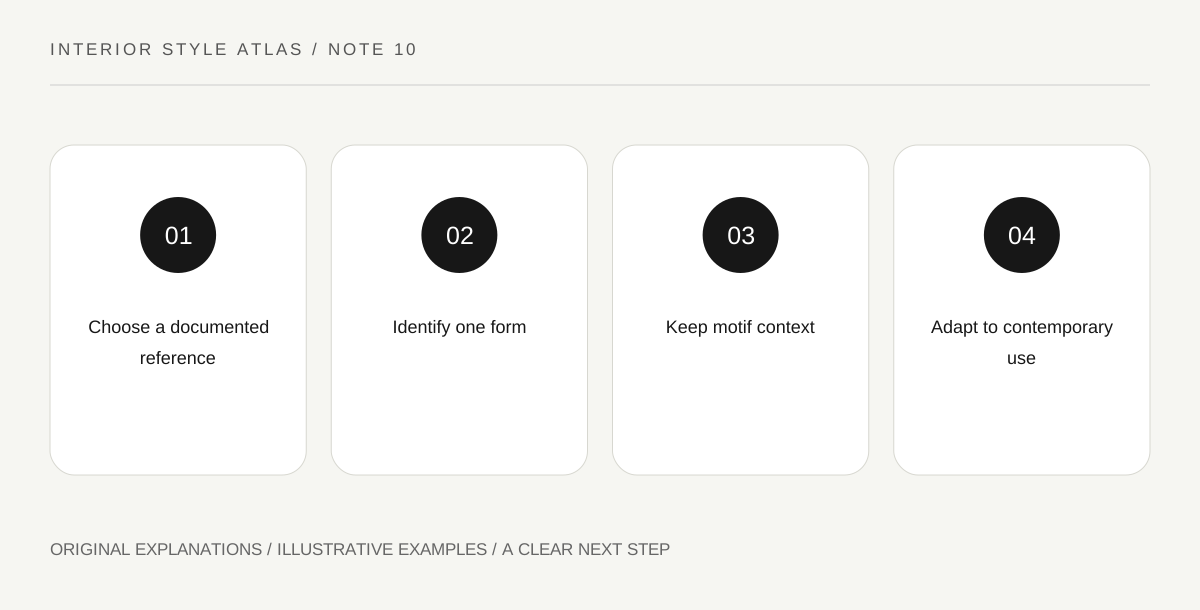
Original explanatory diagram. Read the full method and limitations below.
Distinguish history from a modern mood label
The V&A’s account of Thomas Hope places Regency classicism in a specific history of travel, design and references to ancient Greece and Rome. A modern phrase such as Regency glamour may describe a much looser mixture. Name which kind of reference you are using.
Choose one documented object and identify a support, curve, surface or motif. Avoid assuming that any dark wood and metallic trim establishes the historical style. The specific form and context tell you more than a general association with elegant rooms or costume drama.
Let one form carry the reference
A clearly shaped chair or a frame with a classical detail can be the main reference in a contemporary room. Quiet surrounding pieces may make that form easier to notice. You do not need to turn every useful object into a historical quotation.
Compare the object’s outline with the room’s existing shapes. Does a curved support contrast with a rectangular table? Does a repeated edge connect two areas? Explain the relationship in ordinary terms. That keeps the design decision grounded in what you can see instead of relying only on a prestigious style name.
Compare the silhouette in a plain line drawing with the decorated surface in the original image. You may discover that the clear support and curve matter more to you than the applied motifs, which suggests a quieter way to adapt the reference.
Treat motifs with context
Historical European designers borrowed from multiple cultures, sometimes through unequal or distorted interpretations. Do not describe all those references as interchangeable exotic ornament. Identify a source accurately where possible and distinguish a historical European adaptation from the tradition it referenced.
For an everyday room, you can choose a simple classical shape without collecting anonymous symbolic objects. If a motif’s meaning matters, research it before using a confident label. Decorative enjoyment and accurate attribution can coexist; neither requires pretending that a complex history is a neutral shopping category.
Keep scale and comfort contemporary
A dramatic silhouette is useful only if the item suits your room and activity. Consider comfortable use, access and the space the object occupies. Historical association does not guarantee suitability, quality or structural condition, especially for an older piece.
Create a small paper study using one reference form, a quiet background and a contrasting surface. Compare a restrained version with a more theatrical one. Choose what fits your life, and state that the result is a contemporary interpretation rather than a reconstruction or a claim about an object’s age.
Illustrative classical detail
A reader studies a documented Regency chair and is drawn to its curved support and clear outline. They keep their comfortable contemporary seating and introduce a framed print with a related line instead of buying an unverified antique. A plain table and one reflective object complete the study. The reference is specific, while the room remains openly contemporary.
Practical checks
Optional checkboxes save only in this browser.
Questions that come up
Is every glamorous room Regency-inspired?
No. Glamour is a broad impression, while Regency classicism has particular historical contexts and references. Use a specific source when making a historical claim.
Must I buy dark antique furniture?
No. Study the shape or relationship you enjoy and adapt it with suitable existing pieces. Age and colour do not guarantee authenticity, quality or comfort.
References and scope
These sources support the factual background. Examples and exercises are original illustrative teaching material. References do not imply endorsement.
- Getty Museum: Principles of design — Balance, emphasis, repetition, proportion and visual rhythm in original room exercises.
- Getty Museum: Elements of art — Line, form, colour value, space and texture.
- V&A: Neoclassicism — Classical Greek and Roman references and eighteenth-century design context.
- V&A: Thomas Hope and Regency style — Regency classicism, antiquity references and Thomas Hope’s design context.