Understand Shaker simplicity as more than plain wood
Shaker furniture comes from a particular religious community and set of values. Reducing it to a bare-wood look misses that context and the ingenuity of its forms. Study utility, proportion and honest description, then use those ideas in a contemporary room without claiming to reproduce a community’s way of life.
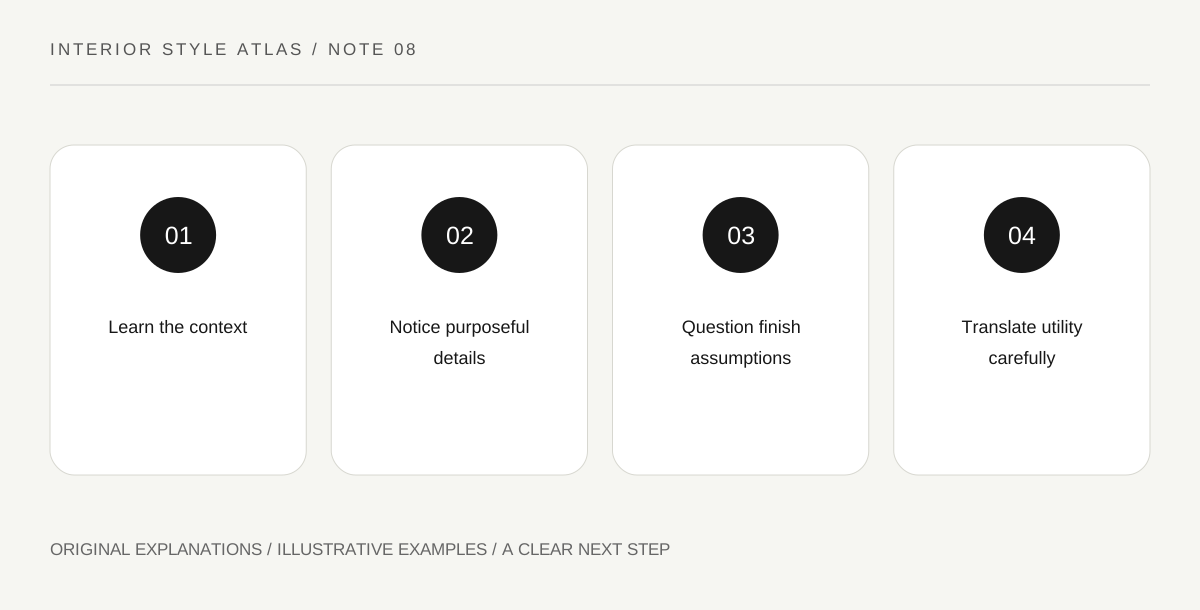
Original explanatory diagram. Read the full method and limitations below.
Keep the historical context visible
The Metropolitan Museum connects Shaker furniture with principles including utility, honesty and simplicity. Those ideas were part of a religious life, not merely a modern retail style. A contemporary cabinet with a familiar door profile is not automatically a historical Shaker object.
Use the label carefully. You can describe an item as Shaker-inspired or note a simple framed construction without making an attribution. Respecting the context means learning what the source actually says rather than treating the community as a decorative synonym for minimalism.
Look for ingenuity within restraint
Simple appearance does not mean no design decisions. Form, proportion and multipurpose arrangements can create interest without applied ornament. Study how a drawer, handle or support serves the object’s use. Ask what has been carefully resolved rather than count how few details are present.
In your room, choose one useful object and examine whether each part has a role. This does not justify removing components or altering furniture. It is a way to notice design: a reachable handle, a clear opening or a proportion that makes the object easy to understand.
An asymmetrical drawer arrangement can be purposeful rather than a break from simplicity. Ask whether each compartment corresponds to an actual use. This shifts attention from matching appearances toward the intelligence of the object’s organization.
Avoid the unfinished-wood assumption
The Met notes that many Shaker pieces were originally painted or stained, and later refinishing can change what survives today. Bare wood is therefore not a universal historical requirement. Keep colour as a possible part of a contemporary interpretation.
Compare a quiet painted surface with a natural-looking one using samples or existing objects. Ask which makes the form clearer and which suits the room. Do not strip an old object to achieve a supposed authentic look; conservation and finish decisions require evidence and appropriate expertise.
Translate utility into a small daily arrangement
Choose an area with a clear purpose, such as a place to set down a cup and book. Select a few objects that perform those tasks and let their forms remain readable. The goal is useful simplicity, not an empty room maintained for a photograph.
For an exercise, write down what each visible item does and what you enjoy about its form. Remove nothing merely to reach a number. A personal object can have a meaningful role even when it is decorative. The historical reference should deepen attention rather than become a rigid rule against possession.
Illustrative useful simplicity
A reader keeps a painted side table, a comfortable chair and a small box for reading glasses. They notice how the table’s plain form and clear handle support use. A single framed family photograph remains because it matters to them. They call the corner a contemporary study in useful simplicity and avoid claiming that pale stripped wood is required by Shaker history.
Practical checks
Optional checkboxes save only in this browser.
Questions that come up
Is all Shaker furniture unpainted?
No. Museum research records painted and stained examples and later refinishing. Do not infer original appearance from the finish you see now.
Can I apply these ideas without buying Shaker-style furniture?
Yes. Observe utility, proportion and clear form in what you already own. Keep the contemporary exercise distinct from claims about historical objects or religious practice.
References and scope
These sources support the factual background. Examples and exercises are original illustrative teaching material. References do not imply endorsement.
- Getty Museum: Principles of design — Balance, emphasis, repetition, proportion and visual rhythm in original room exercises.
- Getty Museum: Elements of art — Line, form, colour value, space and texture.
- Metropolitan Museum: Shaker furniture — Shaker religious context, utility, form, proportion and historically painted furniture.