Find Art Nouveau in the relationship between line and structure
Art Nouveau is often reduced to a decorative curve, yet its designers explored how ornament and structure could belong together. Learn to distinguish that relationship from adding unrelated floral objects. A contemporary interpretation can use a few flowing forms while respecting the movement’s regional variety.
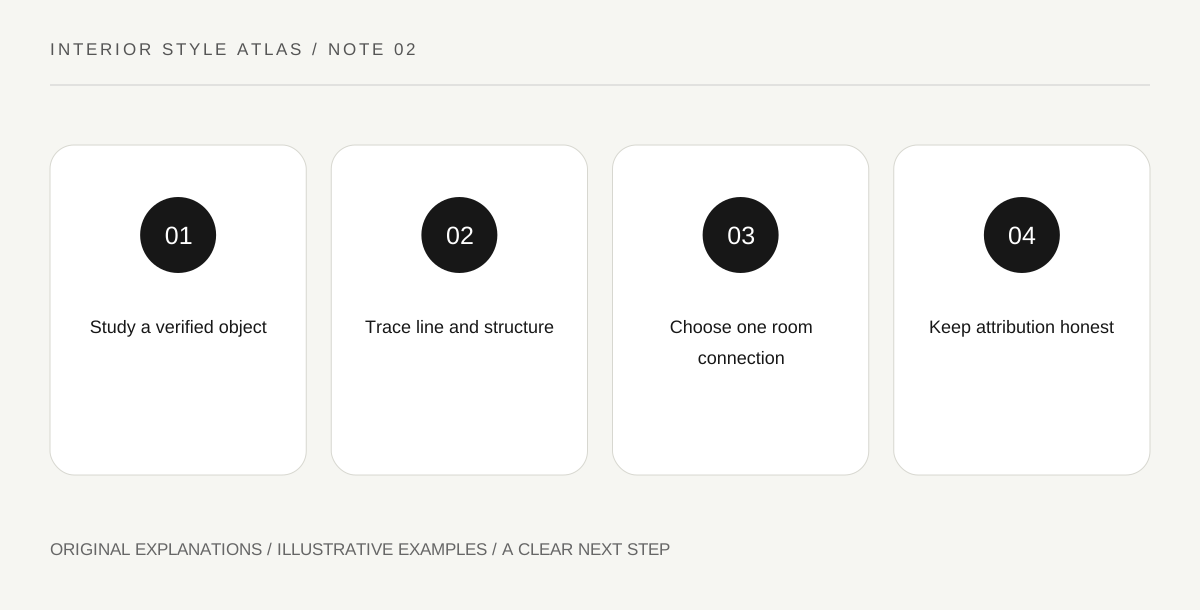
Original explanatory diagram. Read the full method and limitations below.
Look beyond the familiar curving line
Art Nouveau developed internationally with different names and local approaches. Natural forms, fluid lines, geometry and asymmetrical composition all appear in its history. A single sinuous object is therefore a clue, not enough to establish that an entire room or object belongs to the movement.
Study one verified museum example and describe where the line begins and ends. Does a stem-like form become a support, border or handle? This observation is more informative than collecting every object with a flower. It connects visual description to how the object is organized.
Choose one flow through the room
For a contemporary exercise, identify a curve already present in a chair, mirror or textile. Decide whether another object should continue it or offer a quiet contrast. A room does not need every leg, handle and frame to repeat the same bend.
Look at the amount of plain space around the feature. A flowing line can be easier to notice when it is not surrounded by competing ornament. Empty space is not a failure to complete the theme; it can make the chosen detail legible.
Separate natural reference from literal decoration
A design may suggest a plant through its rhythm without depicting a recognizable flower. Conversely, a realistic floral print may have no particular Art Nouveau connection. Ask whether your chosen detail is about shape, surface motif or construction, then use that distinction in the room.
Avoid treating cultural influences as anonymous exotic decoration. If an object or pattern comes from a specific tradition, identify it accurately where possible and do not collapse it into a vague style label. Historical European interpretations and the source traditions are not interchangeable categories.
Adapt through portable details rather than imitation
A textile, framed print or suitable decorative object can explore the line without changing a building. Use original or properly sourced designs and keep attribution clear. This article does not provide restoration, electrical or structural instructions for historical objects or interiors.
Create a small arrangement with one flowing feature, one plain companion and one deliberate contrast. View it from the doorway and from the seat where you use the room. Decide whether the line connects the arrangement or disappears among too many unrelated details. The result is an original styling study rather than a period reconstruction.
Illustrative flowing-line study
A reader has a mirror with a curved outline and a plain side table. They add a textile with an open stem pattern, then remove two unrelated floral ornaments that obscure the line. A simple lamp provides contrast. The arrangement borrows a relationship between flow and structure while making no claim that the existing mirror is an authentic Art Nouveau object.
Practical checks
Optional checkboxes save only in this browser.
Questions that come up
Is Art Nouveau always asymmetrical?
No. The movement includes varied regional approaches, including more geometric and ordered work. Use several verified examples before turning one visual feature into a universal definition.
Can any curving lamp be called Art Nouveau?
Not on shape alone. Attribution needs design, date, maker and context. You can describe a lamp as having a flowing line without assigning a historical identity you have not verified.
References and scope
These sources support the factual background. Examples and exercises are original illustrative teaching material. References do not imply endorsement.
- Getty Museum: Principles of design — Balance, emphasis, repetition, proportion and visual rhythm in original room exercises.
- Getty Museum: Elements of art — Line, form, colour value, space and texture.
- V&A: Art Nouveau, an international style — Natural forms, fluid line, regional differences and integrated decoration.