Build an Art Deco reference without making every surface gold
Art Deco drew together tradition, craftsmanship and a fascination with modern life. Metallic finishes are one possible feature, not a complete definition. Explore geometry, surface contrast and repeated forms in a small room arrangement, while keeping historical objects distinct from a contemporary decorative interpretation.
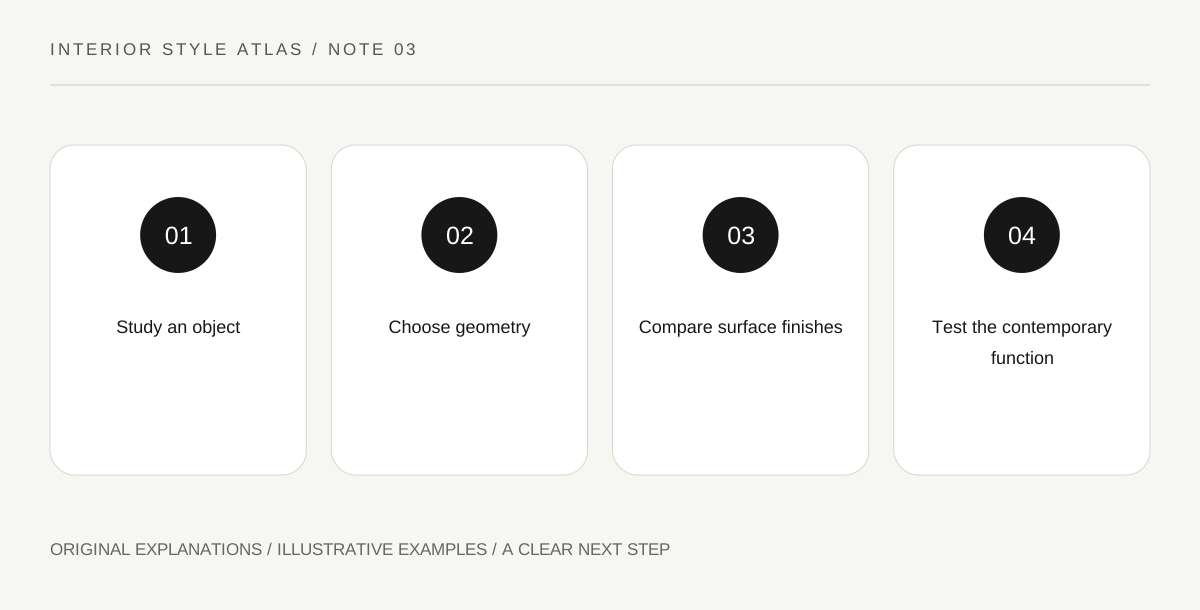
Original explanatory diagram. Read the full method and limitations below.
Recognize a broad design language
The V&A’s Art Deco collection includes furnishings, ceramics, glass, textiles and other objects from the 1920s and 1930s. Their variety makes a single material recipe misleading. Geometry, decorative emphasis and contrasting surfaces can be useful clues, but each object still has its own history.
Begin with a verified object rather than a social-media room labelled Deco. Describe its shape, colour and surface. A stepped edge, clear curve or repeated fan-like form may provide a starting idea. Keep the observation modest instead of claiming that every geometric object belongs to the movement.
Choose one geometric relationship
A rounded chair beside a rectangular table can create a deliberate contrast. A repeated stepped form can connect a frame and textile. Choose one relationship first and see whether it remains visible in the room rather than add a catalogue of period motifs.
Scale matters to the arrangement. A small repeated pattern can read as texture, while a large geometric panel becomes a focal point. Use the actual visible area and room distance to decide which role you want. The same motif can have very different effects at different sizes.
Try viewing the arrangement as a simple light-and-dark sketch. If the stepped shapes and curved outline remain distinct without metallic colour, the composition has a readable structure beyond its decorative finish.
Use sheen with restraint or deliberate abundance
A reflective surface creates contrast with matte fabric or wood. Metallic colour is not the only way to produce that contrast; glass, polished ceramic or a smooth finish can also contribute. You can choose a quiet room with one reflective detail or a more theatrical interpretation.
Check reflections from the positions where you sit and move. A visually striking object may produce unwanted glare or show a reflection you dislike. The style reference does not require accepting a room that is uncomfortable to use. Decorative effect and practical experience belong in the same decision.
Keep contemporary function visible
Choose ordinary useful furniture before decorative references. An original room can include modern equipment and personal objects without hiding them behind false historical claims. The goal is a legible design direction, not a stage set that cannot accommodate daily life.
For an exercise, make a board with one geometric textile, one matte surface and one reflective object. Explain how the three relate. If the only connection is gold colour, try changing that colour while preserving shape and surface contrast. This tests whether the idea has more substance than one finish.
Illustrative geometric arrangement
A reader uses a plain dark sideboard, a rounded mirror and a textile with large stepped shapes. A small glazed bowl supplies reflection. They remove an additional metallic tray because it adds glare without helping the composition. The arrangement references Deco geometry and surface contrast, but the room remains contemporary and the sideboard’s date is not guessed from its appearance.
Practical checks
Optional checkboxes save only in this browser.
Questions that come up
Are Art Deco rooms always black and gold?
No. The movement includes a much wider range of colours, materials and objects. A black-and-gold scheme is one contemporary interpretation rather than a complete historical definition.
Is every fan pattern an Art Deco design?
No. Motifs recur across places and periods. Verify maker, date and context for attribution; use descriptive language such as fan-shaped when historical identity is unknown.
References and scope
These sources support the factual background. Examples and exercises are original illustrative teaching material. References do not imply endorsement.
- Getty Museum: Principles of design — Balance, emphasis, repetition, proportion and visual rhythm in original room exercises.
- Getty Museum: Elements of art — Line, form, colour value, space and texture.
- V&A: Art Deco — Art Deco’s mixture of tradition, modernity and decorative design across furnishings.