Read Arts and Crafts through material, making and repeated pattern
Arts and Crafts is more than a floral wallpaper and dark wood. Its history concerns how objects were made and how a whole interior could relate. Use that context to choose a coherent material and pattern relationship in a contemporary room without pretending to recreate an entire historical house.
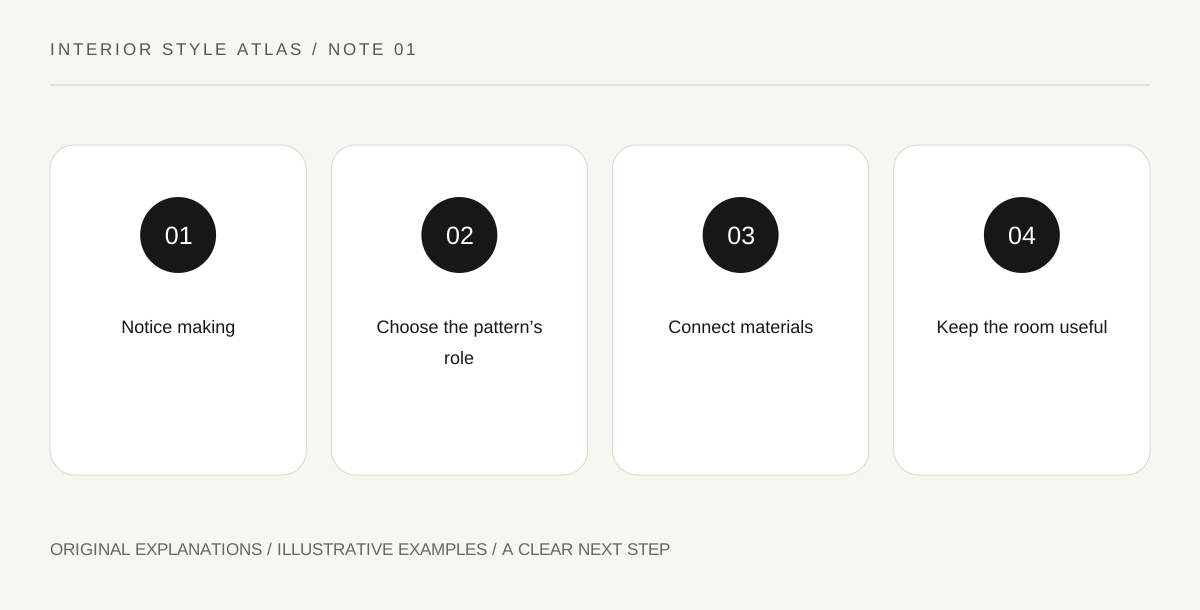
Original explanatory diagram. Read the full method and limitations below.
Begin with making rather than a shopping list
The British Arts and Crafts movement challenged the status of decorative arts and the effects of industrial production. Designers often worked across buildings, furniture and textiles. That history explains why construction and the relationship among objects matter as much as one recognizable motif.
Look at a useful object you already own. Can you see how it is joined, woven or formed? Describe what you appreciate about its making. A contemporary room can borrow that attention without claiming that every handmade item is automatically better or that all machine production must be rejected.
Choose a pattern with a clear role
Plant-based repeats are associated with many Arts and Crafts designs, but their scale and density vary. A densely patterned textile can lead a room, while a smaller area can connect quieter surfaces. Do not assume a historical reference requires covering every available wall or seat.
Use a sample or an existing textile and identify one colour and one repeated form. Let those guide a few companions. The aim is a connected composition, not an exact match across everything. A repeated leaf can inform a curved object without requiring another leaf print.
Let furniture and surface treatment agree
A room can feel coherent when furniture shapes, wood appearance and textiles share a deliberate relationship. That does not mean all wood must match. Notice whether the contrast between a plain frame and a detailed fabric helps each remain readable.
Avoid judging historical quality from darkness or visible grain alone. Material identification, age and attribution require evidence beyond a style impression. For everyday decorating, choose sound, suitable pieces and describe them honestly as inspired by a movement when that is all you know.
Translate the idea into a usable room
Start with one area, such as a reading chair, side table and textile. Give each object a purpose and check that decorative emphasis does not remove the usable surface or comfortable seat. The historical idea of a coordinated interior can guide relationships without requiring a complete makeover.
For an exercise, make a small board showing the existing furniture, a plant-pattern textile and two plain materials. Write one sentence explaining the connection. If the board relies only on the label Arts and Crafts, identify the actual visual or material link before making another decision.
Illustrative craft-led corner
A reader keeps a plain wooden chair and a ceramic lamp they already own. A leafy cushion becomes the strongest pattern, with one muted colour repeated in a simple throw. The side table remains usable. The corner references craft and coordinated pattern but is described as a contemporary interpretation, not an authenticated Arts and Crafts interior or a copy of a named designer’s room.
Practical checks
Optional checkboxes save only in this browser.
Questions that come up
Must an Arts and Crafts-inspired room use only antiques?
No. You can interpret attention to material, making and coordinated pattern with contemporary or existing pieces. Label that interpretation honestly rather than claim period authenticity.
Does any floral print count as Arts and Crafts?
No. Motif alone is insufficient for historical attribution. Look at the designer, date, repeat and context when identifying an object. A floral can be useful in a room without carrying that specific history.
References and scope
These sources support the factual background. Examples and exercises are original illustrative teaching material. References do not imply endorsement.
- Getty Museum: Principles of design — Balance, emphasis, repetition, proportion and visual rhythm in original room exercises.
- Getty Museum: Elements of art — Line, form, colour value, space and texture.
- V&A: Arts and Crafts introduction — Craft, production, material and the concept of a coordinated interior.