Use neoclassical order without turning a room into a temple
Neoclassicism drew on ancient Greek and Roman art and culture, but a contemporary reference need not rely on columns or monumental scale. Study how order, repeated detail and clear form work in a documented object. Then adapt those relationships to a room that still supports ordinary life.
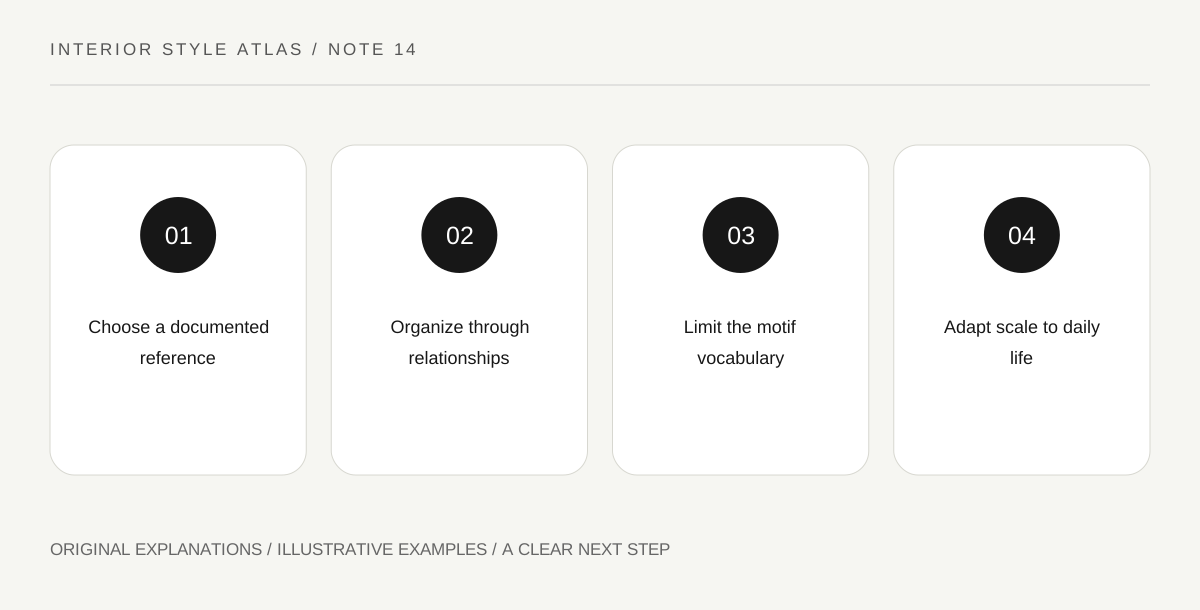
Original explanatory diagram. Read the full method and limitations below.
Start with a specific classical reference
The V&A places the emergence of neoclassicism in an eighteenth-century context influenced by classical antiquity and archaeological discoveries. That history is more specific than using classical to mean anything formal or expensive. Identify the object or interior you are actually studying.
Look for an organized border, repeated motif, clear support or controlled arrangement. Describe what you see before assigning a symbol’s meaning. A pattern resembling a classical motif still needs evidence if you want to make a historical attribution or claim a particular source.
Use order through relationships
An aligned edge, repeated spacing or balanced grouping can create order without adding architectural imitations. Start with existing furniture and identify a reference line such as a cabinet top or artwork edge. Use it to organize a small group.
Exact symmetry is one option, but balance can also use different objects with comparable visual weight. A large quiet object may relate to several smaller ones. Explain the relationship in terms of size, colour and spacing rather than assume paired objects are the only way to make a room feel resolved.
A repeated border can organize a small textile just as a larger architectural edge organizes a room. Try that change of scale on paper to see whether the reference remains recognizable without becoming monumental.
Choose one decorative vocabulary
A border, fluted detail or repeated small motif can provide a reference. Adding several unrelated classical symbols can create confusion rather than depth. Choose what serves the actual arrangement and research meaningful motifs before presenting a confident explanation.
Keep material claims accurate. A stone-like surface is not necessarily stone, and a metallic finish does not establish a particular metal or age. For a contemporary room, visual resemblance can be enough if labelled honestly. You do not need to invent material prestige to justify enjoying a shape.
Adapt scale to the present room
A motif from a monumental setting may need to become a small framed detail or textile pattern in a home. The relationship can remain legible without copying dimensions. Large decorative forms should not remove comfortable access or useful surfaces merely to strengthen a theme.
Create a paper study with one repeated border and a simple grouping of existing objects. Compare a version with strong symmetry and another with looser balance. Note which fits the room’s activity and your preference. This is a contemporary exercise in order, not evidence that the room is historically neoclassical.
Illustrative ordered arrangement
A reader likes the measured border in a documented neoclassical design. They use a framed print with a related repeated edge above a plain cabinet and arrange two different objects with similar visual weight. The room gains a clear order without imitation columns. The print is described as a contemporary reference, while the objects retain their known materials and histories.
Practical checks
Optional checkboxes save only in this browser.
Questions that come up
Does neoclassical mean perfectly symmetrical?
Symmetry is common in many references, but a contemporary exercise can study order and balance without copying every relationship. Use specific examples rather than convert one feature into an absolute rule.
Do I need stone, gilt and antique furniture?
No. Those materials do not define every useful interpretation. Focus on form, repetition and arrangement, and describe contemporary materials honestly instead of treating prestige as a requirement.
References and scope
These sources support the factual background. Examples and exercises are original illustrative teaching material. References do not imply endorsement.
- Getty Museum: Principles of design — Balance, emphasis, repetition, proportion and visual rhythm in original room exercises.
- Getty Museum: Elements of art — Line, form, colour value, space and texture.
- V&A: Neoclassicism — Classical Greek and Roman references and eighteenth-century design context.