Find midcentury character in material experiments, not only tapered legs
Midcentury furniture is often recognized through a few familiar silhouettes, but its history also includes experiments with materials and production. Study how a shaped surface works before collecting period-looking details. Then create a room relationship that includes your present-day needs instead of trying to freeze life into a decade.
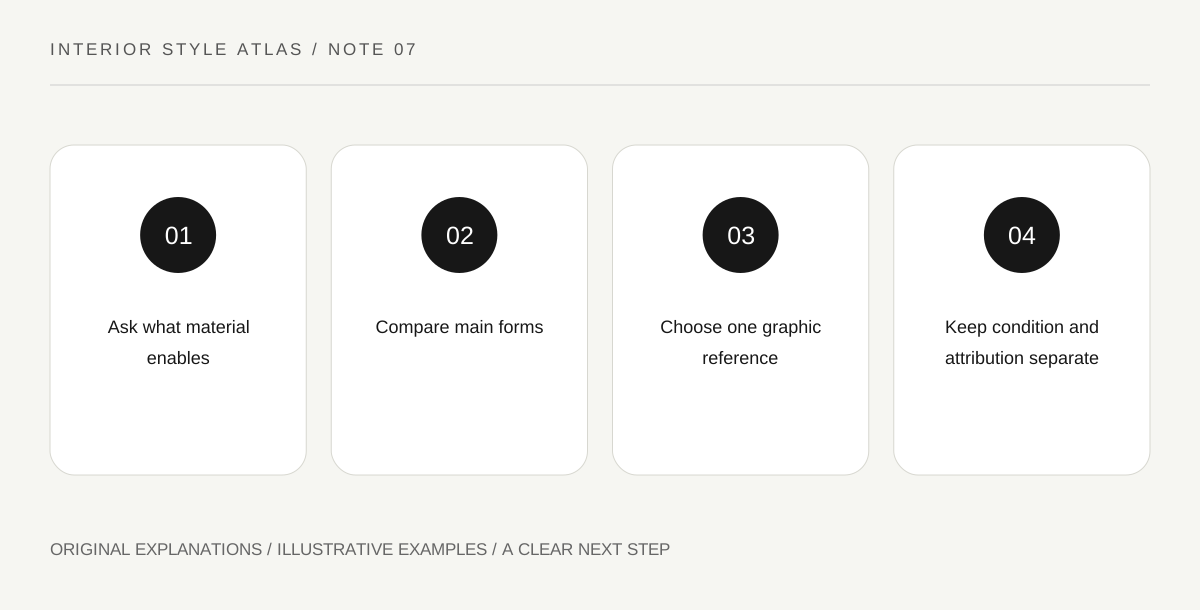
Original explanatory diagram. Read the full method and limitations below.
Start with a material question
The Eames Office’s molded plywood work shows how curved forms and production methods developed together. That is a more informative reference than treating tapered legs as the complete meaning of midcentury design. A material can shape both the object’s form and how it is made.
Choose one documented object and ask what its material permits: a curve, thin shell, visible frame or repeated component. Keep your answer tied to the source. Do not infer that an unknown secondhand item uses the same process merely because its outline resembles a familiar design.
Compare organic and geometric forms
A curved chair can sit beside a rectilinear cabinet and create a clear contrast. Repeating only one kind of shape may be quieter; mixing them may make each more visible. These are composition options, not a requirement that every room contain a particular iconic chair.
Sketch the main furniture shapes before adding small decorative objects. Notice where curves and straight edges already occur. You may find that the room has enough variety and needs only a clearer emphasis rather than another purchase that repeats an existing form.
Compare a curved surface with a flat one made to serve a similar purpose. Notice how the contour changes light and shadow. This can reveal what attracts you to the design without requiring a particular brand or historical object.
Use colour and pattern with a defined role
A graphic textile can provide a period reference while the main furniture remains simple. A saturated colour may become the focal point. Avoid assuming that a contemporary palette associated with midcentury style represents every historical interior of the period.
Choose one pattern or colour relationship and keep it visible. If several small retro motifs compete, decide which actually contributes to the room you want. Removing a redundant reference can make the remaining one more legible without erasing personality or turning the space into a neutral showroom.
Keep vintage appearance separate from condition
An older chair or cabinet needs appropriate assessment for its intended use. Style, age and structural condition are different questions. This article does not provide restoration or authenticity advice; consult suitable expertise for valuable or uncertain objects.
For a practical study, combine one curved form, one clear rectangular form and one textile in a paper board or existing room. Explain what each contributes. Keep contemporary devices and personal items in the plan. A useful interpretation does not require pretending that everyday life has stopped at a historical date.
Illustrative material-led study
A reader studies a documented molded-plywood chair, then notices a similar contrast of curved seat and simple support in a chair they already own. They pair it with a plain rectangular cabinet and one graphic cushion. They describe the arrangement as midcentury-inspired without attributing the existing chair to a designer or assuming its vintage appearance proves sound condition.
Practical checks
Optional checkboxes save only in this browser.
Questions that come up
Do tapered legs make furniture midcentury?
They can be one visual clue, but they do not establish date, designer or origin. Look at construction, documentation and context when identification matters.
Must a midcentury-inspired room avoid new objects?
No. A contemporary interpretation can include new furniture, technology and personal belongings. Borrow specific relationships rather than require the room to function as a period display.
References and scope
These sources support the factual background. Examples and exercises are original illustrative teaching material. References do not imply endorsement.
- Getty Museum: Principles of design — Balance, emphasis, repetition, proportion and visual rhythm in original room exercises.
- Getty Museum: Elements of art — Line, form, colour value, space and texture.
- Eames Office: Molded plywood group — Material experimentation, curved forms and production in midcentury furniture.
- V&A: Furniture collection — Furniture as diverse objects with construction, material and historical context.