Use a Bauhaus reference as a question about design, not a colour checklist
Bauhaus is the name of a historical school and a broad body of work, not a synonym for any white room with primary colours. Learn to ask how an object combines function, material and form. Then make a contemporary arrangement that uses those questions without claiming to reproduce the school’s entire philosophy.
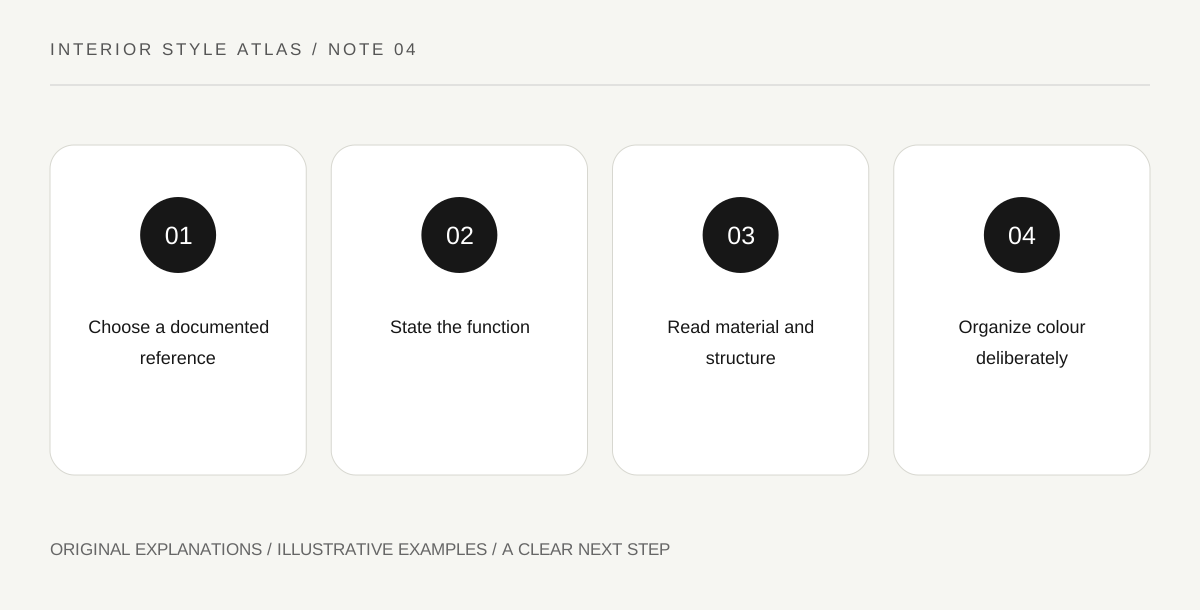
Original explanatory diagram. Read the full method and limitations below.
Begin with a documented object
The Bauhaus-Archiv’s collection shows that objects and media associated with the school are varied. A chair, textile and vessel do not all express the same visual formula. Choose one documented example and identify what problem or material relationship you can actually observe.
Keep attribution separate from resemblance. A tubular chair or geometric rug may be inspired by modern design without being a Bauhaus object. A seller’s label is not enough to establish maker or date. For a room exercise, a clear description of form is more useful than an unsupported prestigious name.
Ask what the object needs to do
A chair must suit the way you intend to sit; a table must support the tasks and objects you place on it. Start with those requirements rather than choose a recognizable silhouette first. A historical reference does not make an uncomfortable or unsuitable item function well for you.
Write a short use statement before arranging the area. For example, this corner is for reading and placing a cup. Then identify which forms serve those actions. This makes function a concrete question, not an aesthetic word added after the room has already been decorated.
Make material and structure readable
Observe how supports, planes and surfaces relate. A visibly light frame can contrast with a solid top, while a woven surface can introduce texture within a simple geometry. You do not need to strip away all softness or decoration to appreciate those relationships.
Avoid treating exposed construction as proof of quality or safety. A joint can look interesting while still requiring proper product information or assessment. The exercise concerns visual clarity; it does not instruct you to alter furniture, remove components or use an object beyond its intended purpose.
Use colour as an organized choice
Primary colours can provide a graphic reference, but they are not mandatory in every contemporary room influenced by modernist design. Choose where colour marks a plane, distinguishes an object or creates emphasis. A random collection of bright accessories does not automatically explain a design relationship.
Create a paper study of three simple shapes representing the main objects. Assign one accent colour and leave the others quieter. Then compare the study with the real room, including texture and light. The exercise translates a design question into your circumstances rather than promises historical authenticity.
Illustrative function-first corner
A reader needs a chair, light and cup surface. They choose existing items that work comfortably, then notice a clear contrast between a thin chair frame and a solid tabletop. One blue object marks the small surface without adding several decorative colours. They call the result a contemporary modernist study and keep the Bauhaus reference as a learning source, not an attribution.
Practical checks
Optional checkboxes save only in this browser.
Questions that come up
Does Bauhaus mean no decoration?
That is too broad. The school’s work varied across disciplines and time. Study specific objects and ideas instead of reducing a historical institution to a universal ban on ornament.
Can I identify a Bauhaus chair by metal tubing?
No. Tubular construction appears in many designs. Attribution requires evidence about designer, maker, date and model, not one material or silhouette.
References and scope
These sources support the factual background. Examples and exercises are original illustrative teaching material. References do not imply endorsement.
- Getty Museum: Principles of design — Balance, emphasis, repetition, proportion and visual rhythm in original room exercises.
- Getty Museum: Elements of art — Line, form, colour value, space and texture.
- Bauhaus-Archiv: Collection — Primary collection context for Bauhaus objects and design research.
- V&A: Furniture collection — Furniture as diverse objects with construction, material and historical context.