Translate De Stijl’s planes and lines into a small composition
De Stijl offers a way to think about separate planes, rectilinear structure and colour relationships. It is more specific than simply adding red, yellow and blue. Study a documented example, then use a paper exercise to understand the relationships before deciding whether any of them belong in your room.
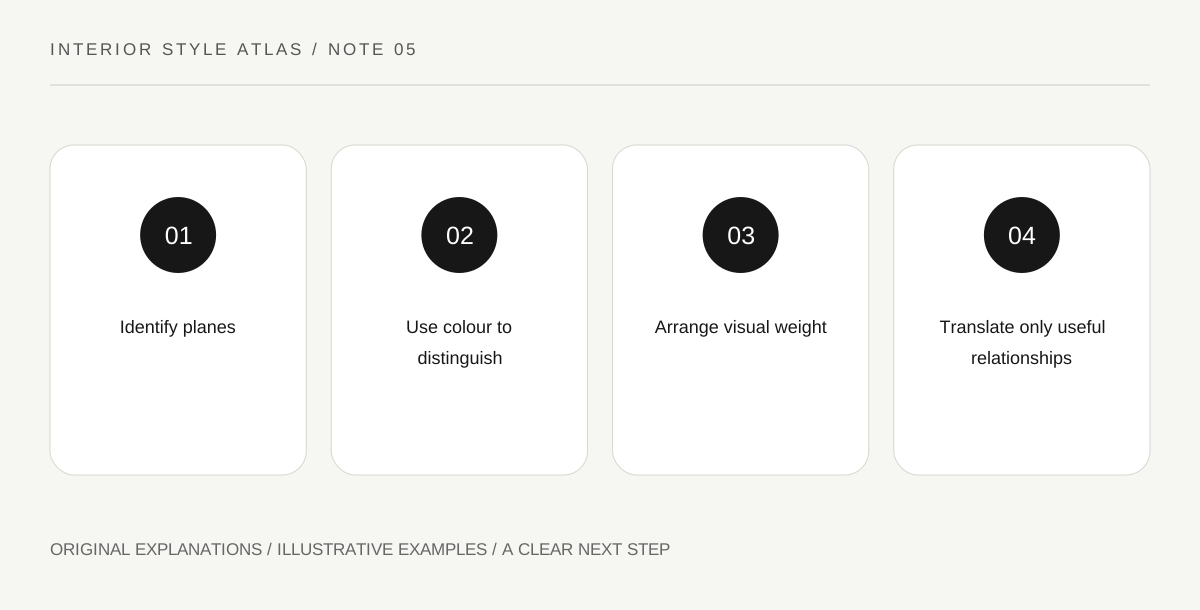
Original explanatory diagram. Read the full method and limitations below.
Look at parts rather than a solid mass
MoMA describes Rietveld’s Red Blue Chair through interacting vertical and horizontal planes and simple construction. The object helps explain a design approach in which parts retain a clear identity. You do not need to own or reproduce the chair to study that visual relationship.
Draw a chair or shelf you already have using only its main lines and planes. Notice which parts support and which are supported. This is an observation exercise, not a building plan. Do not remove parts or alter a product to make its appearance closer to the sketch.
Understand colour as a distinction among elements
The familiar chair’s primary-colour scheme was applied after its initial design. That history is a reminder that object stories can be more complex than a single iconic photograph. In a composition, different colours can make separate surfaces or supports easier to read.
Try colouring one plane and leaving the others quiet. Then compare a version in which every part has a different colour. Ask whether the distinction helps you understand the arrangement or creates more activity than you want. Colour has a role beyond supplying a recognizable historical palette.
Use asymmetry without random placement
An arrangement can be asymmetrical while still having a deliberate relationship among parts. A larger quiet area can sit beside a smaller intense colour. The goal is not to center every item or scatter them unpredictably, but to decide how visual weight is distributed.
Use paper rectangles on a board to represent a wall, furniture and one decorative object. Move them until you can explain the relationship. Keep the exercise on paper first, where revision is easy. The result may inform an arrangement without requiring paint or permanent changes.
Keep a room distinct from an abstract artwork
A lived room needs comfortable access, useful surfaces and the objects its occupants require. A striking abstract study is not automatically a workable interior. Translate only the relationships that serve the actual space, and preserve the functions that the drawing omitted.
For a final comparison, make two studies with the same rectangles and colours but different spacing. Identify which leaves the clearest emphasis. Then write what you would borrow and what you would leave on paper. This keeps inspiration specific instead of turning the movement into an all-or-nothing room theme.
Illustrative plane study
A reader sketches an existing white shelf as horizontal and vertical planes. On paper, they add one blue rectangle representing a storage box and a small red artwork nearby. The first arrangement feels crowded; moving the artwork creates a clearer gap. They borrow the spacing idea while keeping the real shelf unchanged and using it according to its intended design.
Practical checks
Optional checkboxes save only in this browser.
Questions that come up
Must a De Stijl reference use all three primary colours?
No contemporary exercise requires that. Study the historical context, then choose a specific relationship to explore. Using every familiar colour without organizing planes does not necessarily communicate the idea.
Can a paper composition become a furniture-building plan?
Not by itself. Visual observation does not establish structural design or safe construction. Keep this exercise decorative and consult appropriate expertise for any actual fabrication or alteration.
References and scope
These sources support the factual background. Examples and exercises are original illustrative teaching material. References do not imply endorsement.
- Getty Museum: Principles of design — Balance, emphasis, repetition, proportion and visual rhythm in original room exercises.
- Getty Museum: Elements of art — Line, form, colour value, space and texture.
- MoMA: Rietveld’s Red Blue Chair — Rectilinear planes, construction and the chair’s connection with De Stijl.