Read Danish Modern beyond a beige-room stereotype
Danish Modern includes varied furniture and design experiments, not one mandatory palette of pale wood and beige fabric. Begin with a specific documented object and consider its construction, comfort and visual character. A contemporary room can learn from that attention without turning an entire country into a decorative shorthand.
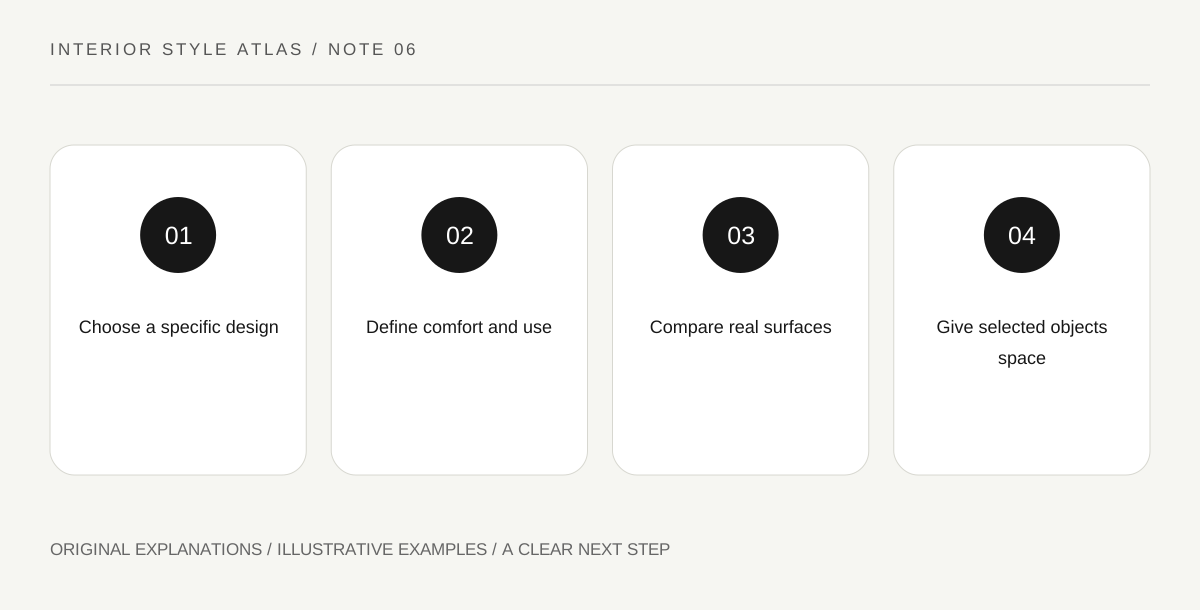
Original explanatory diagram. Read the full method and limitations below.
Study a design rather than a national stereotype
Designmuseum Danmark presents Danish design as a history with different makers, materials and approaches. That breadth matters when a style label is reduced to a few colours. Choose an object with a known designer and context rather than assume every pale wooden chair has the same origin.
Describe its actual qualities: curved support, woven seat, strong colour or a shaped shell. A country label alone does not explain those features. You can appreciate one approach and dislike another without deciding whether your taste is sufficiently Scandinavian.
Give comfort a specific meaning
A chair’s appearance does not tell you whether it suits your body, table or activity. Consider seat height, access and the kind of sitting you intend, using the actual item and appropriate product information. Historical recognition is not a substitute for personal suitability.
For a room exercise, start with a chair you already find useful. Identify which visual qualities you enjoy and which practical qualities matter most. Keep those lists separate. You may borrow a material relationship from a museum example while retaining a different chair that works better in your home.
A useful comparison can hold colour constant while changing form. Two similarly coloured chairs may have very different visual weight because one reveals its frame and the other reads as a continuous upholstered volume.
Use wood and textiles as distinct surfaces
Wood tone, grain, finish and shape all contribute to a room. A woven seat or textile adds another surface rather than simply making the room cozy by category. Look at the real contrast between smooth, textured, light and dark areas.
Different woods can coexist through repeated shapes or a shared light-dark relationship. There is no requirement to match every item exactly. Likewise, colour can be present. Choose what connects the composition instead of assuming neutrality is the only route to a calm room.
Make restraint purposeful
Leaving space around a well-shaped object can make its construction easier to appreciate. That is a design choice, not a requirement to remove meaningful belongings. Decide which objects deserve attention and which can remain ordinary useful background.
Create a small study with one shaped chair, one textile and one useful surface. Add a colour you enjoy and explain its role. If the arrangement depends on purchasing a famous name, revise it using the qualities you actually want. The purpose is understanding, not collecting a compulsory set of icons.
Illustrative object-led room
A reader admires a documented Danish chair’s clear frame but keeps an existing chair that suits their sitting needs. They borrow the idea of visible structure, add a woven textile and choose a deep-blue cushion rather than beige. The room remains personal, and no unverified item is labelled Danish solely because its wood is pale.
Practical checks
Optional checkboxes save only in this browser.
Questions that come up
Does Scandinavian style require white walls?
No universal rule follows from that broad label. Different places, periods and designers use colour differently. Look at specific references and your own room rather than treat one retail image as a regional definition.
Do I need designer originals?
No. This is a learning and decorating exercise. Identify the qualities you value, use suitable existing objects and be honest about attribution. A famous name does not guarantee practical fit.
References and scope
These sources support the factual background. Examples and exercises are original illustrative teaching material. References do not imply endorsement.
- Getty Museum: Principles of design — Balance, emphasis, repetition, proportion and visual rhythm in original room exercises.
- Getty Museum: Elements of art — Line, form, colour value, space and texture.
- Designmuseum Danmark — Danish Modern as a varied design history rather than a single neutral colour scheme.
- V&A: Furniture collection — Furniture as diverse objects with construction, material and historical context.