Give a Memphis-inspired object room to be playful
Memphis sits within a broader postmodern design context of play, reference and challenges to established taste. A colourful geometric object can be a starting point, but the label should not replace observation. Explore its form and humour while deciding how much visual activity you want around it.
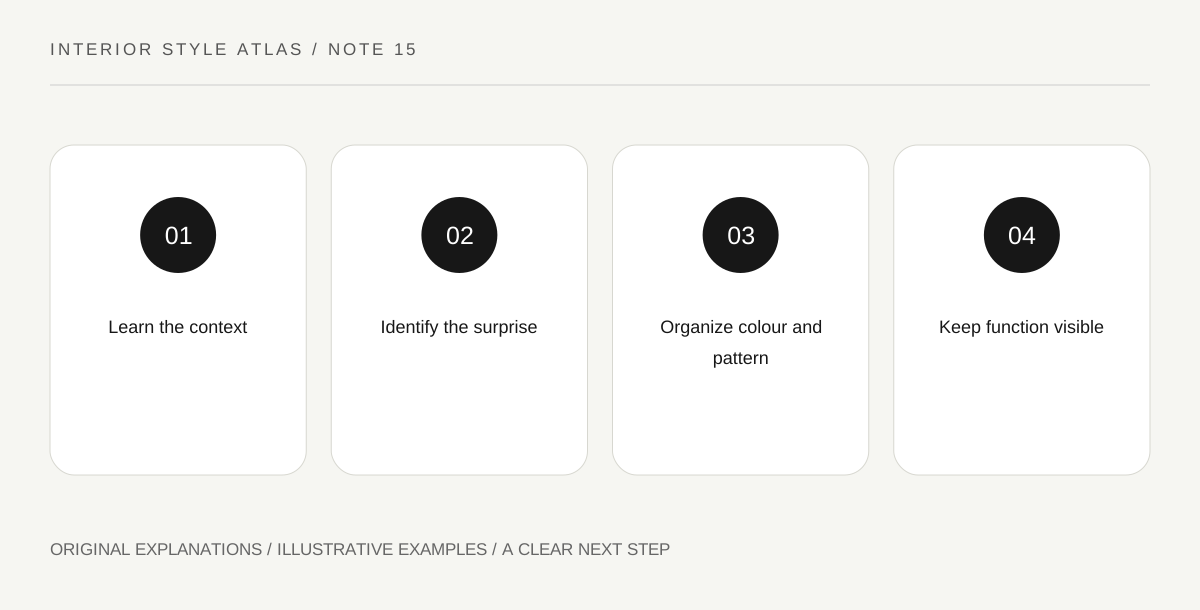
Original explanatory diagram. Read the full method and limitations below.
Keep Memphis within its context
The V&A’s postmodern design resource discusses playfulness, mixed references and reactions to modernist ideas. Its examples include Sottsass’s furniture designs. Memphis is not a synonym for every bright object or every piece with a zigzag pattern, so attribution still requires evidence.
Choose a documented design and ask what makes it surprising. It may combine familiar furniture functions with unexpected forms, colour or surface. The useful lesson is the deliberate challenge to expectation, not a requirement to add random patterns until the room becomes busy.
Identify the object’s main joke or contrast
A support may look unlike a conventional leg, or a storage object may read almost like a sculpture. Describe that effect plainly. Humour can come from proportion, material appearance or an unexpected reference, and different viewers may respond differently.
In a contemporary arrangement, let one playful object remain clear enough to be understood. Quiet surroundings are one option. A deliberately energetic group is another, but choose the relationship rather than assume more colour always strengthens the idea.
Try drawing the object without colour or pattern. Does its unusual form still surprise you? Then add surface treatments one at a time. This separates a joke carried by shape from one carried by decoration and helps explain why two equally colourful objects can feel very different.
Use pattern and colour as structure
A patterned surface can distinguish a part of an object, while a strong colour can mark another plane. Look at where each begins and ends. If the pattern merely obscures the form you enjoy, consider whether the surrounding items need to become quieter.
Make a paper version using simple shapes and two or three contrasting surfaces. Move the parts without buying anything. Ask whether the result has a clear surprise or only unrelated activity. This keeps the exercise about composition and intent rather than a shopping category labelled quirky.
Preserve the function you need
A sculptural object still needs to serve its intended purpose safely if used as furniture. Check actual product information and condition. A decorative image cannot establish stability, capacity or suitability, and this article does not offer fabrication instructions for experimental forms.
For a practical study, place one playful object in an existing room and observe it from the places you use. Decide whether it deserves focus, supports another feature or feels intrusive. You can enjoy the reference without adopting a complete postmodern environment or defending it as universally good taste.
Illustrative playful focal point
A reader owns a contemporary geometric vase with contrasting colours. They place it on a plain cabinet, then compare it with several patterned objects nearby. The quieter arrangement makes its unexpected shape easier to read. They call the study Memphis-inspired without attributing the vase to the group, and keep the cabinet surface useful for daily needs.
Practical checks
Optional checkboxes save only in this browser.
Questions that come up
Is every colourful geometric object Memphis?
No. Those features appear in many designs. Use maker, date and documented context for attribution; use inspired by when describing an original contemporary interpretation.
Must a playful room be visually crowded?
No. A quiet background can make one playful object more legible. Density is a choice, and the right amount depends on what you want to notice and how you use the room.
References and scope
These sources support the factual background. Examples and exercises are original illustrative teaching material. References do not imply endorsement.
- Getty Museum: Principles of design — Balance, emphasis, repetition, proportion and visual rhythm in original room exercises.
- Getty Museum: Elements of art — Line, form, colour value, space and texture.
- V&A: Postmodern design collection resource — Playfulness, reference, mixed styles and the broader context of Memphis.