Organize a maximal room through repetition and meaningful variety
A richly layered room can contain many colours, objects and patterns while still giving the eye something to follow. This contemporary exercise uses repetition and grouping to organize variety. Begin with what matters to you and decide which relationships should lead, rather than fill surfaces simply to achieve a label.
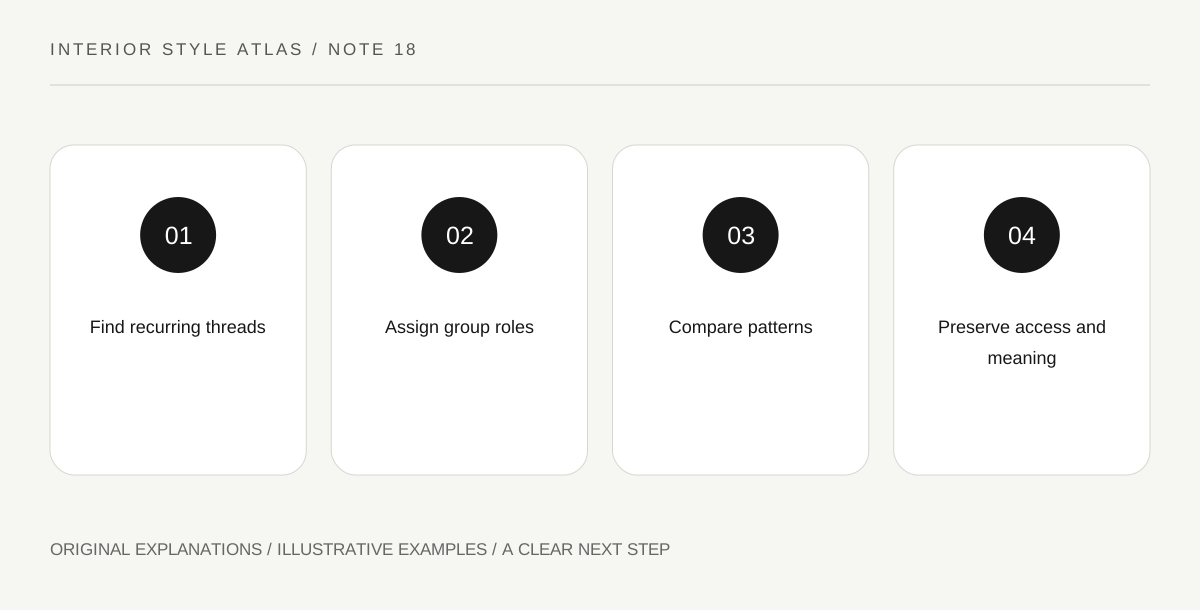
Original explanatory diagram. Read the full method and limitations below.
Choose the room’s recurring threads
A repeated colour, curved form or material can connect otherwise varied objects. Pick a few threads you can actually see in your belongings. The connection need not be literal matching, and it should not require inventing histories for objects whose origins are unknown.
Write why the chosen things matter: use, memory, shape or pleasure. A maximal room can express several kinds of meaning. The exercise should help them coexist rather than demand that every object fit a single invented theme or that more purchases are necessary to make the room complete.
Create groups with different roles
One group may be the main focal point, another a quieter supporting area. If every surface has the same density and contrast, the room may feel harder to read. Variation in group size and spacing can make richness more intentional.
Arrange a small collection around one larger piece or a clear frame such as a tray or shelf section, where appropriate. Do not force fragile items into unstable stacks for visual effect. A group needs to remain practical to access and maintain, not merely impressive from one angle.
Mix patterns by identifying their differences
Compare scale, spacing, contrast and direction. Two busy patterns may work if they have a clear connection and enough distinction to remain readable. A small dense repeat can behave like texture beside a larger open motif. These are observations to test, not universal permissions or prohibitions.
Use samples or existing textiles and view them in the actual room light. Colour names can hide differences in intensity and value. If the combination feels too dense, change one area or introduce a plain surface before replacing everything. A targeted revision reveals what caused the effect.
Preserve access and personal choice
Richness should not block necessary movement or make useful surfaces unusable. Consider how the arrangement is handled during ordinary activities. Objects can be meaningful and still need a different location. Editing a group does not require rejecting the person or memory it represents.
For an exercise, photograph or sketch one area before and after regrouping, without buying anything. Identify what became clearer and what meaning was preserved. The goal is organized variety at a density you enjoy, not a competition to own the most objects or defend every arrangement as a style statement.
Illustrative layered display
A reader has books, travel sketches and several ceramics. They group the sketches near one larger drawing, repeat a blue tone in two ceramics and leave a plain area beside the books. They move a fragile item away from an unstable stack. The room remains rich, but its connections and access become clearer without adding another decorative purchase.
Practical checks
Optional checkboxes save only in this browser.
Questions that come up
Does maximalism mean keeping every surface full?
No. This contemporary interpretation uses gaps and variation to make richness legible. Density is a choice rather than an obligation to fill every available area.
Can unrelated personal objects belong together?
Yes. Their relationship can come from arrangement, colour, form or personal meaning rather than shared origin. Describe them honestly and avoid inventing a theme that misrepresents their histories.
References and scope
These sources support the factual background. Examples and exercises are original illustrative teaching material. References do not imply endorsement.
- Getty Museum: Principles of design — Balance, emphasis, repetition, proportion and visual rhythm in original room exercises.
- Getty Museum: Elements of art — Line, form, colour value, space and texture.
- V&A: Aesthetic Movement introduction — Art for art’s sake, artistic domestic display and multiple design influences.
- V&A: Postmodern design collection resource — Playfulness, reference, mixed styles and the broader context of Memphis.