Create an industrial reading through structure without faking damage
Industrial is used loosely in contemporary decorating. Here it means an original visual study of frames, functional-looking forms and contrasting surfaces, rather than a claim that a room has factory history. Work with what exists and distinguish an appealing raw appearance from actual damage or unsuitable material.
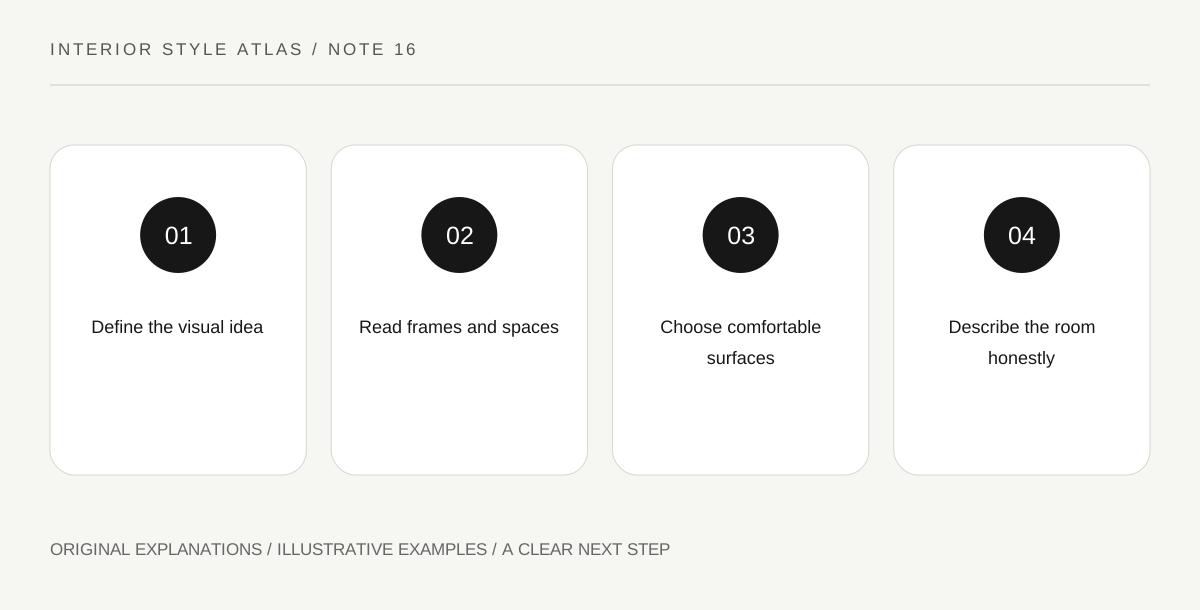
Original explanatory diagram. Read the full method and limitations below.
Define the visual idea you mean
A metal frame, simple utility form or visible support can create an industrial association. These are descriptive observations, not proof of an object’s origin. A new table with a metal base is still a new table unless documentation establishes another history.
Choose one quality to explore: exposed frame, repeated mechanical-looking line or contrast between smooth and rough surfaces. This gives the room a specific direction. The word industrial alone is too broad to decide whether a shelf, lamp and chair relate to one another.
Use real structure as a composition element
Look at supports and the spaces between them. A thin frame can make a solid surface appear lighter, while repeated uprights create rhythm. These relationships can be studied with existing furniture without removing covers or components to expose something that was not designed to be visible.
Keep product function separate from appearance. A decorative pipe-like element may not carry load, and an old-looking frame may not be sound. Use furniture according to its instructions and obtain appropriate assessment for uncertain items rather than treat visible structure as proof of strength.
Compare the frame in daylight and under the room’s ordinary evening light. Thin dark members may merge into a single area in one condition and remain distinct in another. That observation can guide nearby surface contrast without adding fake mechanical components or changing the frame itself.
Balance surface contrast with comfort
A rough-looking surface can contrast with a smooth textile, but actual sharp edges, unstable finishes or damage are not style requirements. Do not distress a surface or use an unknown industrial object merely to make the room feel authentic. The visual reference can be achieved without inventing wear.
Softness can be practical as well as decorative. Choose seating and touch surfaces that suit their use, then decide how they relate to the clearer frame. A room does not become less coherent because it includes a comfortable cushion or personal artwork.
Avoid a fictional building story
If the room has genuine historic industrial features, research and treat them appropriately. If it does not, describe the arrangement as a contemporary interpretation. Faux provenance adds nothing useful and can encourage unnecessary or damaging alterations.
For an exercise, use one framed object, one smooth surface and one textured textile. Sketch their main lines and compare the amount of dark and light area. Decide whether the contrast serves the room’s activity. Keep the result decorative; structural, electrical and restoration changes require appropriate expertise.
Illustrative frame-led room
A reader keeps a modern metal-framed table and a comfortable upholstered chair. They add a plain storage box and a textured cushion, then remove a decorative object with a sharp damaged edge. The room’s industrial association comes from clear supports and surface contrast. They do not invent a reclaimed factory origin for furniture purchased new.
Practical checks
Optional checkboxes save only in this browser.
Questions that come up
Do industrial interiors need exposed brick?
No. This is a contemporary visual interpretation, not a required material list. Frames, lines and surface relationships can provide the association without changing the building.
Is rust or wear necessary for authenticity?
No. Damage is not a design requirement. Genuine historic objects need appropriate assessment, and a new room can explore the visual idea honestly without adding artificial deterioration.
References and scope
These sources support the factual background. Examples and exercises are original illustrative teaching material. References do not imply endorsement.
- Getty Museum: Principles of design — Balance, emphasis, repetition, proportion and visual rhythm in original room exercises.
- Getty Museum: Elements of art — Line, form, colour value, space and texture.
- V&A: Furniture collection — Furniture as diverse objects with construction, material and historical context.