Borrow the Aesthetic interior’s attention to display with accurate context
The Aesthetic Movement treated the domestic interior as a place for visual enjoyment and artistic expression. Its references were eclectic and historically specific. Learn to arrange objects through line, spacing and repeated detail, while avoiding the idea that unfamiliar cultural objects are interchangeable props for an artistic room.
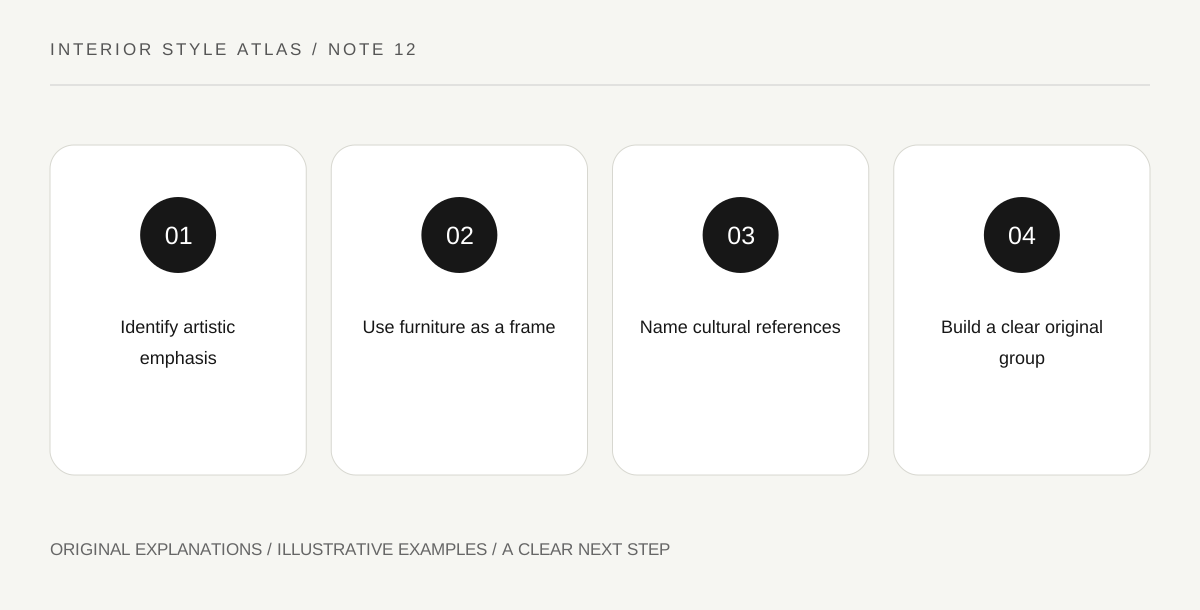
Original explanatory diagram. Read the full method and limitations below.
Understand the artistic emphasis
The V&A describes the Aesthetic Movement through an emphasis on beauty and art for art’s sake, with a reshaping of domestic taste. That context differs from a generic instruction to make a home look expensive. The historical interest lies in relationships among art, design and everyday surroundings.
Choose one verified interior or object and describe what creates visual pleasure: an elegant line, flat pattern, contrast or a carefully placed object. Keep the description specific. A broad label such as artistic is less useful than identifying the relationship you would like to explore.
Treat display furniture as a frame
A cabinet, shelf or overmantel can organize objects rather than simply hold as many as possible. Notice vertical and horizontal divisions and the space around each item. A frame can connect varied objects without making them identical.
Use an existing surface and place one main object first. Add a smaller companion, then leave a gap. Observe whether the group reads clearly from the position where you normally see it. This is an original arrangement exercise, not an attempt to reproduce the contents of a named historic home.
Give cultural references their own identity
Aesthetic designers drew on multiple cultures and periods, including interpretations of East Asian design. Historical fascination does not make the source traditions anonymous. If you own an object from a particular place or practice, identify it accurately where possible and consider whether display is appropriate.
Avoid describing every unfamiliar motif as exotic or assuming a modern reproduction carries the same meaning as a documented historical object. You can enjoy a pattern while acknowledging what you do not know. Accurate naming enriches a room more than a vague story added to make it feel worldly.
Use motif without making a costume
A bird, flower or geometric line can connect objects across a group, but it need not appear on every surface. Choose whether the motif is a focal point or a subtle echo. Too much repetition can obscure the differences that made the objects interesting.
For a practical study, arrange three existing items around one shared line or colour and one deliberate contrast. Write a short caption describing each honestly. Keep access and care needs in mind, especially for fragile pieces. The exercise should make your own belongings more legible rather than create a shopping list of historical symbols.
Illustrative artful group
A reader groups a documented local ceramic bowl, a personal drawing and a plain vase on an existing cabinet. The drawing’s curve echoes the bowl’s rim, while the vase offers a vertical contrast. They leave space around the objects and keep their actual histories in the description. The arrangement borrows an interest in artful display without treating cultural origin as decorative mystery.
Practical checks
Optional checkboxes save only in this browser.
Questions that come up
Is an Aesthetic-inspired room just a collection of antiques?
No. Arrangement, visual relationships and artistic attention matter. Existing contemporary objects can support an original study, while antique status alone does not create a coherent or historically accurate interior.
Should I copy every motif from a historical room?
No. Choose a specific relationship that interests you and research meaningful references. A contemporary room can acknowledge history without reproducing a whole set of symbols outside their context.
References and scope
These sources support the factual background. Examples and exercises are original illustrative teaching material. References do not imply endorsement.
- Getty Museum: Principles of design — Balance, emphasis, repetition, proportion and visual rhythm in original room exercises.
- Getty Museum: Elements of art — Line, form, colour value, space and texture.
- V&A: Aesthetic Movement introduction — Art for art’s sake, artistic domestic display and multiple design influences.
- V&A: Furniture collection — Furniture as diverse objects with construction, material and historical context.